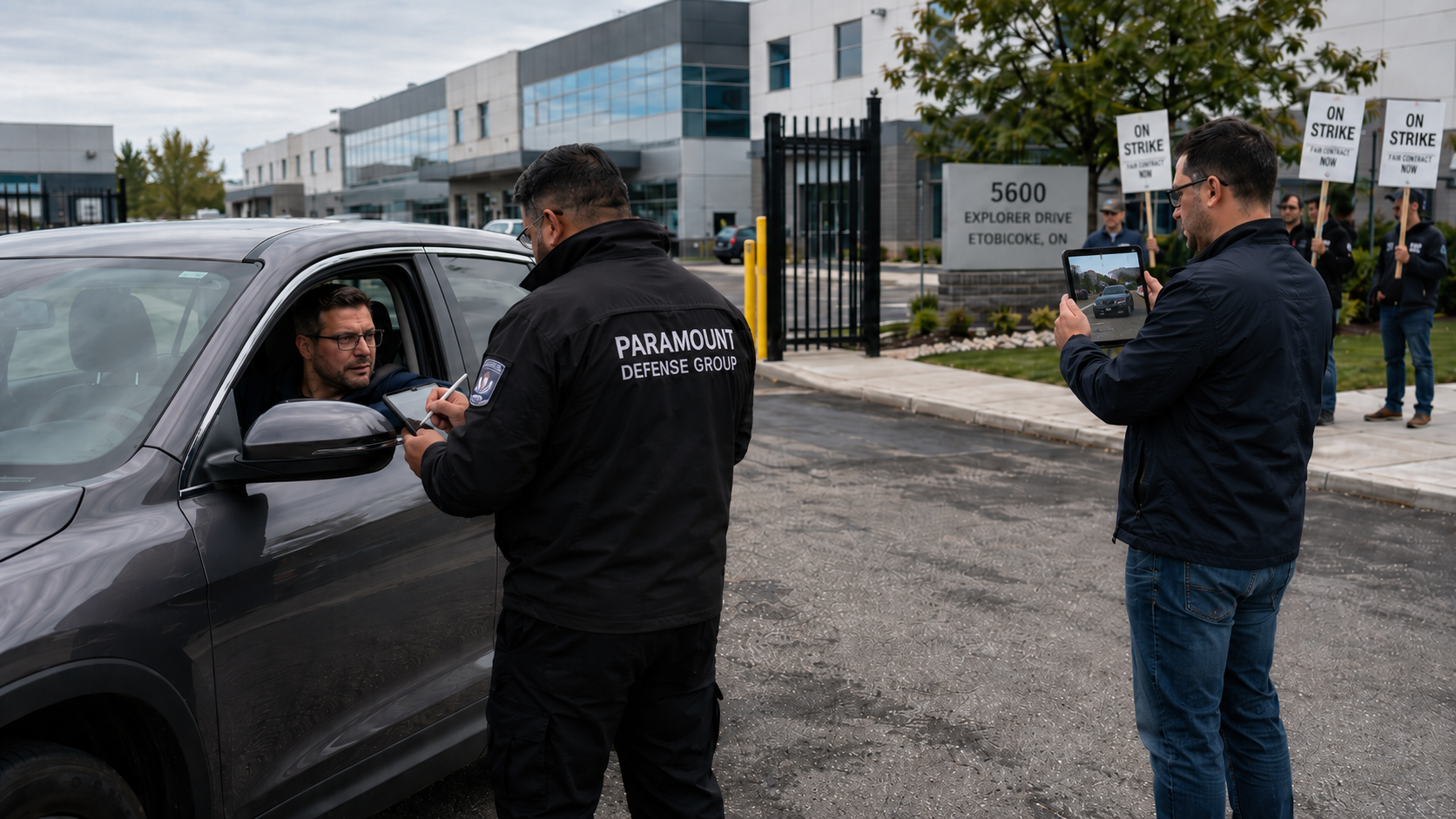
Labour disputes can create serious challenges for organizations across Toronto and the Greater Toronto Area. In addition to operational disruption, employers must consider employee safety, public access, legal exposure, business continuity and reputational risk.
Effective strike security is not about preventing lawful protest. It is about maintaining a safe, controlled environment in which employees, union members, contractors, visitors and members of the public can exercise their rights without unnecessary confrontation.
This guide provides HR, legal, labour relations and operations teams with a practical framework for preparing for, managing and reviewing security during a strike or lockout in Ontario. For teams that want an operational partner, Paramount Defense Group offers labour dispute security in Toronto and across Canada.
Understanding Strike and Picket Line Security in Ontario
Lawful strikes and peaceful picketing are protected activities within Ontario's labour relations framework.
Peaceful picketing may include holding signs, speaking with employees or members of the public, distributing information and communicating support for a labour position. Security planning should recognize and respect these rights.
Conduct may become a safety or legal concern when it involves:
- Threats or intimidation
- Violence or harassment
- Property damage
- Dangerous interference with vehicles
- Serious obstruction of entrances or emergency routes
- Breaches of court orders or police direction
The purpose of a strike security plan should be to reduce risk, prevent escalation and maintain accurate documentation while preserving lawful protest activity.
Before the Strike
Conduct a Site-Specific Risk Assessment
Identify the locations and operations that could be affected by a labour dispute, including offices, warehouses, plants, loading docks, parking areas, staff entrances, vehicle gates and sensitive infrastructure.
Document who uses each access point, when traffic is highest and which entrances must remain available for emergency services.
Organizations should also define the difference between manageable disruption and a situation that presents an unacceptable risk to people, property or operations. Structured strike security consulting for Ontario employers can accelerate this assessment.
Establish a Labour Dispute Response Team
Identify the people responsible for managing the organization's response.
The team may include representatives from:
- Human resources
- Labour relations
- Legal counsel
- Operations
- Corporate security
- Communications
- Health and safety
- Senior management
Each person should understand their role and decision-making authority.
The organization should also establish clear escalation procedures, including who contacts legal counsel, emergency services, union representatives, security providers and the media.
Develop Realistic Security Scenarios
Prepare for several possible situations rather than relying on a single security plan.
Potential scenarios may include:
- Peaceful picketing with limited disruption
- Delayed vehicle or employee access
- Large gatherings near entrances
- Confrontations involving staff or contractors
- Interference with deliveries
- Harassment or threatening behaviour
- Property damage or vandalism
- Social-media campaigns targeting the organization
- Medical or traffic-related emergencies
For each scenario, consider the possible impact on safety, operations, legal exposure and public reputation.
During the Strike
Create Safe and Predictable Access Routes
Develop safe access procedures for employees, contractors, deliveries and visitors.
Where appropriate, organizations may use separate routes or scheduled arrival windows for non-striking employees, management personnel, contractors, delivery vehicles and emergency services.
Access plans should be communicated clearly and should avoid unnecessary interaction or confusion at the picket line.
Maintain a Neutral and Professional Security Presence
Security personnel assigned to labour disputes should remain visible, calm and non-confrontational.
Their role is to support:
- Safe access
- Traffic movement
- Incident prevention
- De-escalation
- Emergency response
- Objective documentation
- Protection of people and property
Personnel should understand that peaceful picketing is lawful and that intervention should be based on safety concerns, property protection or clearly defined legal requirements.
Establish De-Escalation Procedures
Employees and contractors should receive clear instructions before approaching a picket line.
They should be advised to remain calm, avoid arguments, follow approved access routes, allow security personnel to manage difficult interactions and report incidents through internal channels.
A designated point of contact should also be established for communication with union representatives or picket captains.
Regular communication about traffic, access, emergency routes and safety concerns can often resolve issues before they escalate.
Incident Reporting and Evidence Management
Use Standardized Incident Reports
All significant incidents should be documented consistently and objectively.
An incident report should include:
- Date and time
- Exact location
- Individuals involved, when known
- Witness information
- A factual description of what occurred
- Actions taken by security or management
- Police or emergency-service involvement
- Photographs, video or supporting documents
- Follow-up requirements
Reports should avoid assumptions, emotional language or conclusions that are not supported by evidence.
Peaceful and lawful activity should not be treated as a security incident merely because it occurs during a strike.
Review Camera and Surveillance Coverage
Review whether existing cameras adequately cover entrances, exits, parking areas, loading zones, vehicle routes, perimeter areas and public-facing locations.
Video may help establish an accurate timeline when an incident is disputed.
Organizations should maintain clear procedures for accessing recordings, preserving important footage, recording who handled the evidence, preventing unauthorized sharing and establishing appropriate retention periods.
Coordinate Documentation with Labour Counsel
Management and legal counsel should agree in advance on which incidents require immediate consultation.
Examples may include:
- Serious threats
- Repeated unsafe obstruction
- Assault or attempted assault
- Significant property damage
- Dangerous interference with vehicles
- Breaches of a court order
- Conduct that creates an immediate public-safety risk
Accurate documentation allows counsel to assess whether the matter should be addressed through dialogue, negotiation, police involvement, an Ontario Labour Relations Board proceeding or an application to the courts.
Protecting Employees, Contractors and the Public
Brief Non-Striking Employees and Contractors
Employees, temporary workers and contractors who may need to enter the site should receive a short safety briefing.
The briefing should explain:
- Where to enter and exit
- Who to contact before arriving
- What to expect at the picket line
- How to respond if approached
- What behaviour should be reported
- What to do if access is temporarily delayed
- When to leave the area and seek assistance
Individuals should not attempt to negotiate access, challenge protesters or respond to verbal confrontation.
Update Emergency Response Plans
Existing emergency plans should be adjusted to account for strike conditions.
Organizations should consider ambulance and fire-service access, on-site first aid, evacuation routes, emergency assembly areas, traffic congestion, procedures for large gatherings and access for employees with disabilities.
Everyone involved should understand who has authority to contact emergency services and direct the response.
Protect Drivers, Visitors and Community Members
Suppliers, drivers and visitors should receive instructions before arriving.
Organizations may need to reschedule deliveries, use alternative entrances, provide a security escort, establish waiting areas, install temporary signage or adjust vehicle routes to reduce congestion.
Clear communication can prevent confusion and reduce the likelihood of conflict.
Communications and Reputation Management
Use Consistent Public Messaging
Designate one spokesperson to handle external statements.
Public communications should be factual, measured and respectful.
Messaging should emphasize:
- Respect for lawful protest
- Commitment to employee and public safety
- Cooperation with relevant parties
- Continuity of essential operations
- A desire for constructive resolution
Organizations should avoid inflammatory statements, personal accusations or comments that could prejudice negotiations or legal proceedings.
Monitor Media and Online Activity
Traditional media and social platforms can quickly influence public understanding of a labour dispute.
The communications team should monitor news coverage, public posts about the facility, reports of safety incidents, false or misleading information, images involving security personnel and credible threats.
Responses should be coordinated with legal and labour-relations teams.
Consider the Public Appearance of Security Operations
Photographs and videos of a picket line can circulate widely.
Security personnel should maintain professional conduct and appearance at all times.
This includes remaining calm, avoiding unnecessary physical contact, keeping entrances orderly, using respectful language, following established procedures and avoiding unauthorized media comments.
The security posture should communicate preparedness and control, not intimidation.
After the Strike
Conduct a Formal Post-Strike Debrief
After the dispute has ended, conduct a formal review involving HR, legal counsel, labour relations, operations, security, health and safety, communications and relevant union representatives where appropriate.
The review should examine:
- Which procedures worked
- Where delays or confusion occurred
- Whether staffing levels were appropriate
- How incidents were documented
- Whether communication channels were effective
- How employees and third parties experienced the process
- Whether the security posture remained neutral and professional
Frontline employees, security officers and union representatives may provide especially valuable practical feedback.
Update Policies and Vendor Arrangements
Lessons from the dispute should be incorporated into future planning.
Organizations may need to revise standard operating procedures, emergency plans, access-control policies, employee training, incident-reporting forms, vendor agreements, escalation protocols and media-response procedures.
When reviewing a strike security provider, consider labour-dispute experience, de-escalation capability, documentation quality, supervisory structure, professionalism, licensing, insurance and understanding of Ontario requirements.
Support the Return to Normal Operations
The end of a strike does not immediately eliminate tension.
Organizations should communicate clearly about return-to-work procedures, changes to site access, updated safety measures, outstanding incident reviews, restoration of normal schedules and expectations for workplace conduct.
A transparent post-strike process can help rebuild confidence and support a more stable working environment.
Employment Standards and Scheduling Considerations
Staffing changes made during a strike or lockout should be reviewed carefully.
Hours of work, rest periods, overtime, temporary staffing and adjusted schedules may be affected by Ontario employment standards, collective agreements and other legal obligations.
HR and operations teams should consult labour counsel before implementing arrangements that significantly change working hours, employee duties, shift lengths, rest periods, contractor responsibilities, temporary staffing or access to the workplace.
Professional Strike Security Services in Toronto
A well-designed labour dispute security plan protects more than a facility. It protects employees, union members, contractors, visitors, business operations and the organization's reputation.
Paramount Defense Group provides professional security support for strikes, lockouts and labour disputes across Toronto, Ontario and Canada.
Our approach includes:
- Labour dispute risk assessment
- Picket line security
- Safe employee and vehicle access
- De-escalation
- Incident reporting and evidence management
- Emergency response coordination
- Executive and employee protection
- Operational continuity planning
Every labour dispute is different. Security measures should be proportionate, legally informed and tailored to the location, workforce and level of risk.