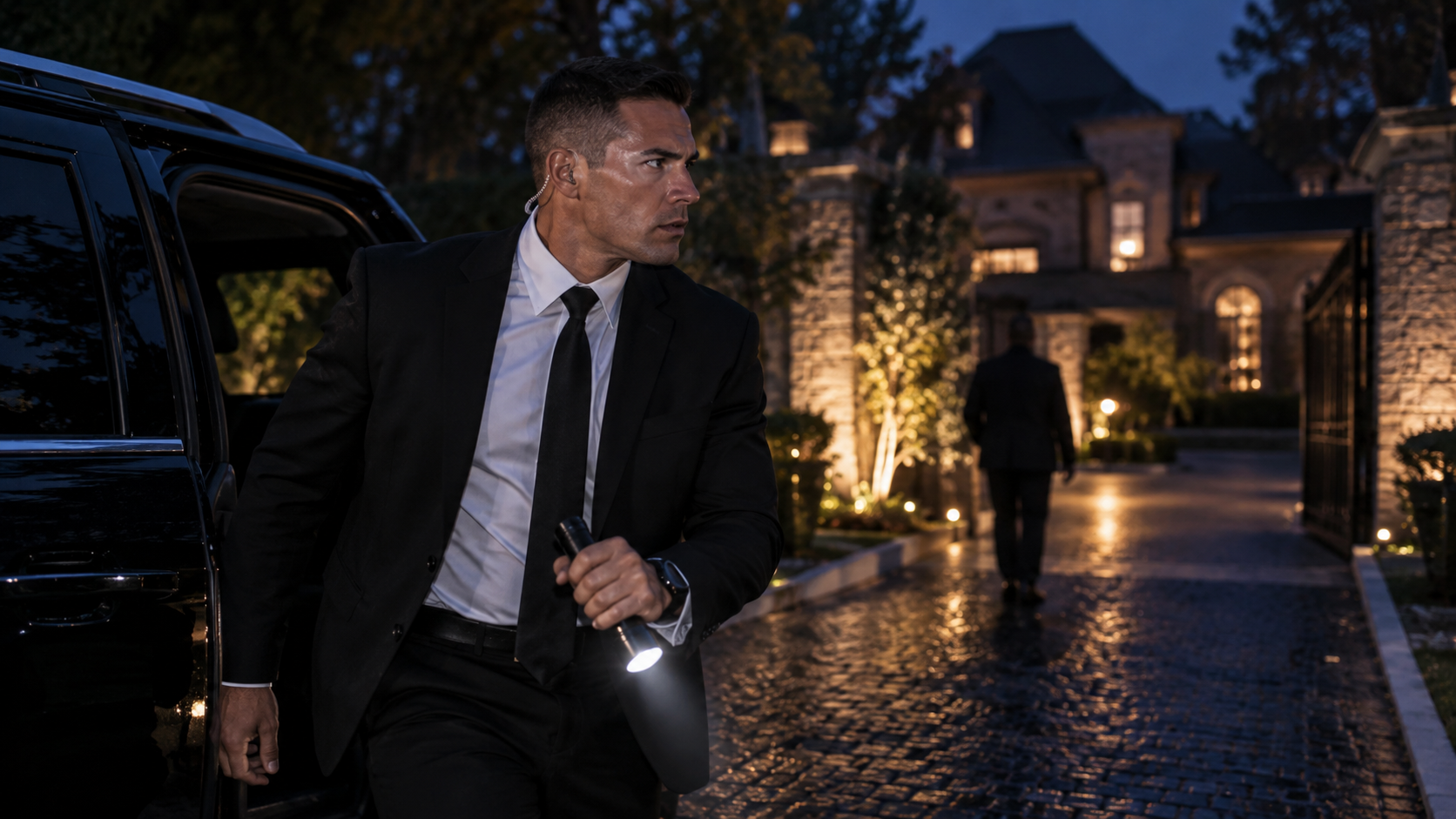
Residential security is often discussed in terms of technology. Homeowners are shown cameras, alarm panels, motion sensors, access-control systems, video analytics and increasingly sophisticated forms of perimeter detection. All of these systems have value, and in a well-designed security program they can provide excellent situational awareness. The problem is that detection is only one part of protection.
When an alarm activates or a camera identifies suspicious movement, the security problem has not been solved. In many cases, it has only just started.
The real question is what happens next.
Who receives the information? How quickly is the event verified? Is there somebody close enough to respond? Does that person understand the property? Can they reach the relevant part of the site without losing valuable time? Are they able to communicate useful information to police or other emergency services if escalation becomes necessary?
These questions are particularly important when protecting larger residences and private estates, where the distance between the property boundary and the occupants can be substantial. A home may have an impressive electronic security system, but if there is no effective response behind that system, the homeowner may ultimately be left with little more than a very good recording of what happened.
For residential security, response time is not a secondary operational consideration. It is part of the security architecture itself.
Detection and intervention are two different things
Modern security technology has improved enormously. Cameras can identify movement in low light, analytics can distinguish between certain types of activity, alarm systems can immediately notify monitoring centres, and homeowners can receive live alerts on their phones almost anywhere in the world.
What none of these systems can do independently is physically manage an incident.
A camera can detect a person approaching a rear boundary. It cannot determine their intention with certainty and it cannot prevent them from continuing toward the residence. An alarm can identify that a door has been opened, but it cannot establish control over the property. A mobile notification can tell a homeowner that movement has been detected while they are away, but it may leave that homeowner trying to interpret several camera feeds from another city or another country.
The value of technology therefore depends heavily on the response structure attached to it.
A good residential security plan should create a clear sequence from initial detection to verification, decision-making and physical response. The shorter and more organized that sequence is, the more useful the entire security system becomes.
This is why we look closely at response capability when assessing residential properties. The objective is not simply to determine whether an intrusion can be detected. It is to determine whether the security system creates enough time for meaningful action to be taken before the situation reaches the occupants.
Large residential properties create a particular response problem
The issue becomes more complex with high-value homes and private estates because these properties are rarely simple from a security perspective.
A larger property may include long driveways, detached garages, service entrances, landscaped areas, mature trees, swimming pools, outbuildings and sections of perimeter that cannot be seen from the residence. Some properties back onto ravines, golf courses, wooded land or neighbouring estates. Others have multiple pedestrian and vehicle access points.
These features are desirable from a privacy and lifestyle perspective, but they also create security challenges.
An intruder does not necessarily have to approach from the driveway or the front gate. In fact, the most obvious entrance may be the least attractive route for somebody attempting to enter unnoticed. Rear boundaries, side yards and heavily landscaped areas can offer significantly more concealment.
That means the distance between initial entry onto the property and the residence itself can become an important security factor.
If an estate has a perimeter extending hundreds of feet from the house, detecting somebody at the boundary gives security more time to react than detecting that same person after they have already reached a patio door. The earlier the detection occurs, the more options are available.
However, early detection only improves security if the response is capable of using that additional time.
A perimeter alarm that activates ten minutes before somebody reaches the residence is useful if security can respond within that window. It is far less useful if the nearest responding officer is thirty or forty minutes away.
For that reason, response capability has to be considered at the same time as cameras, sensors and alarm placement. Technology should be designed around the response model, and the response model should be designed around the actual property.
Response time is not simply a matter of driving fast
Security companies sometimes talk about response time as though it were only a question of how quickly a patrol vehicle can travel from one location to another. In reality, there are several different components that determine how long an effective response takes.
The first is detection. An event has to be identified.
The second is verification. Somebody has to determine whether the alert requires action.
The third is dispatch. The information needs to reach the responding officer with enough detail to be useful.
Only then does travel time begin.
Once the officer arrives, there is another part of the response that is often overlooked: reaching the correct location on the property.
On a large estate, arriving at the street address is not necessarily the same as arriving at the incident. The responding officer may have to enter through a controlled gate, travel a significant driveway, determine which part of the property generated the alarm and then move safely toward that location.
A company could therefore advertise a very attractive response time while still taking considerably longer to place an officer where that officer is actually needed.
Traffic is another unavoidable factor in the Greater Toronto Area. A patrol model that works well at 2:00 in the morning may perform very differently during afternoon traffic. Road construction, weather, special events and congestion can all alter the practical response time to a property.
That is why security planning should be based on realistic operating conditions rather than the theoretical distance between a patrol vehicle and the residence.
Where patrol units are normally positioned, how large their coverage areas are, how many properties they are responsible for and what happens when more than one client requires assistance at the same time all affect response capability.
These are operational questions, but for the homeowner they have a direct impact on protection.
Familiarity with the property can be as important as speed
Fast arrival is valuable, but an officer who reaches the property quickly and then has no idea where to go may lose much of that advantage.
For higher-value residences, site familiarization should be part of the security program.
Responding personnel should understand the basic layout of the estate, including primary and secondary access points, gates, perimeter lines, common alarm zones and any parts of the property that present particular security concerns.
They should also know how access will be handled during an incident. If the main gate is locked, who can open it? Is there an emergency access procedure? Is there a keyholder? Can the monitoring centre remotely authorize entry? Are there dogs on the property? Are there domestic staff, contractors or family members who may legitimately be moving around the property at unusual hours?
These details matter because uncertainty consumes time.
Imagine an officer being dispatched to a rear-perimeter alarm at a large residence. If the officer already knows the property, understands which camera corresponds to the alarm zone and knows the fastest way to reach that section of the perimeter, the response can begin almost immediately.
If the officer has never been there before, the first several minutes may be spent simply trying to understand the environment.
This is one reason residential security should not be treated as an interchangeable patrol service. A stronger model combines response capability with property-specific knowledge.
The purpose of rapid response is not confrontation
There is another important point that is sometimes misunderstood.
Fast response does not mean that a security officer should immediately confront every suspicious person who appears near a residence. The purpose of professional security is not to manufacture confrontation. The purpose is to assess the situation, reduce risk and protect the occupants.
Depending on the circumstances, an effective response may involve observing and reporting, increasing visible presence, checking the perimeter, positioning between a potential threat and the residence, contacting the homeowner or coordinating with police.
In some situations, the arrival of a security vehicle alone may cause a suspicious person to leave. In others, the officer may be able to confirm that the alarm was caused by a contractor, delivery driver, family member or wildlife.
The important point is that somebody is physically present and able to make an informed assessment.
Without that presence, the homeowner and monitoring centre may be forced to make decisions using incomplete information from cameras and sensors alone.
Private security and police response should complement each other
Police remain essential when a residential incident involves an active threat, criminal entry, violence or another situation requiring law-enforcement authority. Private security should never be presented as a replacement for police.
The two functions can, however, complement each other.
A security officer already positioned near the property may be able to verify an incident and provide information while police are responding. That can help clarify what officers are being sent into.
There is a significant difference between reporting that a residential alarm has activated and reporting that a trained security officer has observed an individual inside the rear perimeter, can provide a physical description and can identify the direction in which that individual is moving.
Better information can improve decision-making.
A security officer can also remain at the property after an incident, help maintain access control, assist the homeowner and preserve relevant information until the situation is resolved.
This additional layer becomes particularly valuable when homeowners travel frequently or when a residence is unoccupied for extended periods.
Security assessments should measure response, not just equipment
When reviewing a residential security program, it is easy to become focused on hardware because hardware is visible.
A homeowner can count cameras. They can see gates, sensors and alarm keypads. They can compare specifications and technology.
Response capability is less visible, but it may ultimately matter more.
A serious residential security assessment should therefore examine the practical response chain.
It should consider how quickly an event is likely to be detected, how that event is verified, who receives the information, where responding personnel are normally located, what traffic and access conditions may affect them, how they enter the property and what they are expected to do after arrival.
It should also identify whether the current security system detects threats early enough.
If most sensors are located on the building itself, security may receive its first warning only when somebody is already at the house. Moving detection outward toward the perimeter can create additional time, but only if the response system is capable of taking advantage of it.
This is why residential security should be designed as a complete system rather than a collection of individual products. The Ontario government's Crime Prevention Ontario framework likewise describes prevention as anticipating, recognizing and appraising crime risk and taking action to remove or reduce it.
The question every homeowner should be able to answer
A homeowner should know what happens after an alarm activates.
Not in theory, but in practical terms.
They should know who receives the alert, who decides whether somebody should be dispatched, where that person is likely to be coming from, how long the response normally takes and what the responder will do once they arrive.
If nobody can answer those questions clearly, there is an important weakness in the security plan.
At Paramount Defense Group, an Ontario-licensed security company operating under Private Security Business Licence No. 30000196, we believe effective residential and estate security requires more than installing technology and waiting for something to happen. Protection should combine early detection, verification, informed decision-making and a realistic physical response capability.
For larger homes and private estates across Toronto and the GTA, particularly properties with extensive grounds, wooded boundaries, multiple access points or periods of regular vacancy, response planning should be considered from the beginning of the security assessment.
A camera can show that somebody entered your property. An alarm can tell you that a door was opened. The security program determines what happens next.
And in a genuine residential security incident, the time between those two moments can make all the difference.