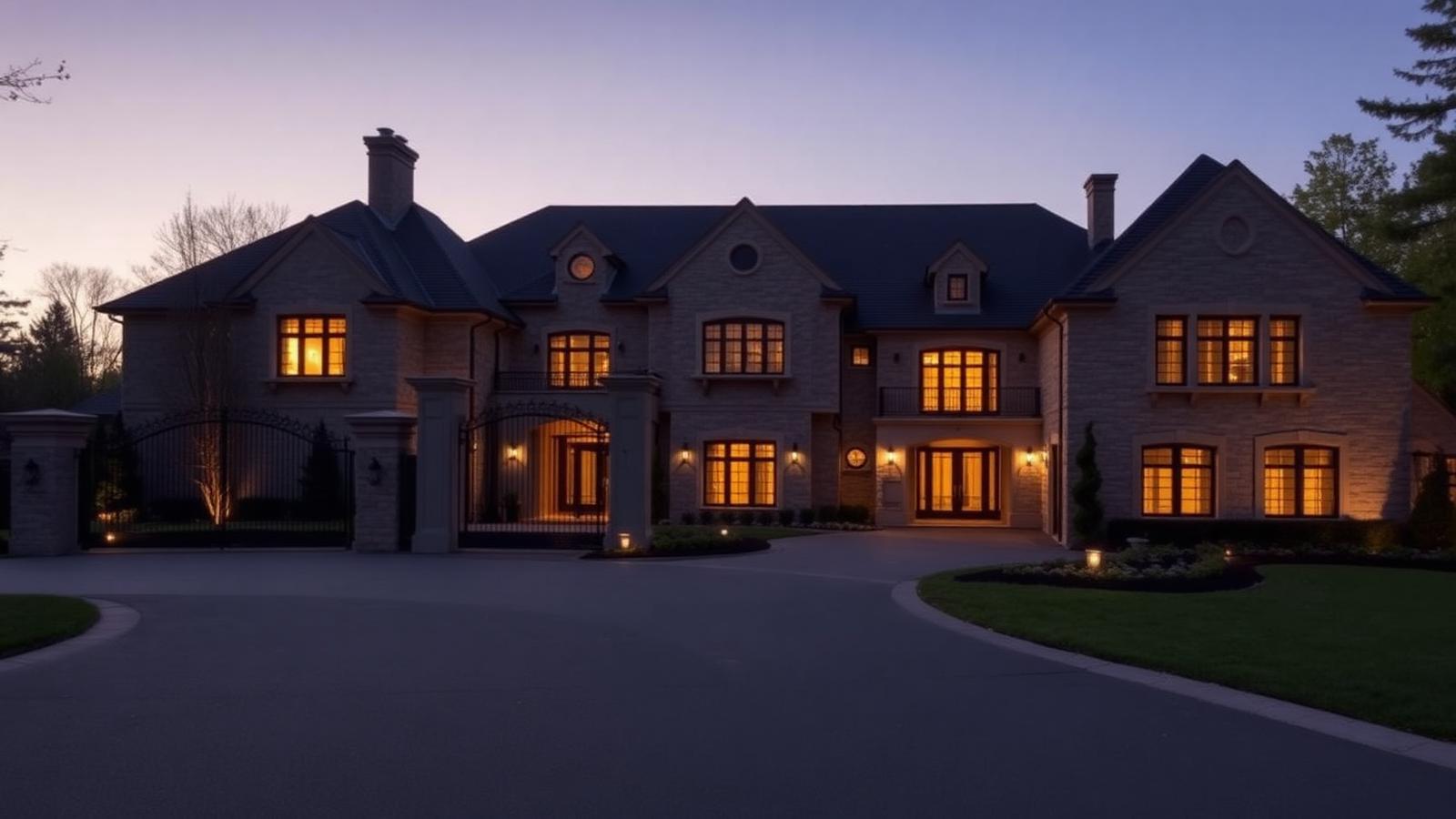
A well-designed residential security program should protect daily life, privacy and continuity — not make a home feel institutional. For Toronto-area homeowners, estate managers and family offices, the goal of a serious audit is to confirm that everything already in place is proportionate to the risk, integrated across staff and technology, and quietly effective in the background of ordinary family life.
This guide provides a practical framework for reviewing residential and estate security in Toronto. It is written for principals who already have a home security posture and want an honest, structured way to test whether it still fits the household, the property and the current threat environment.
1. What a Professional Estate-Security Audit Examines
A residential security assessment is not a sales exercise or a technology sweep. It is a structured review of how a household actually lives, who has access, how information flows, and how the physical property, systems and people respond when something is unusual.
An honest audit examines:
- The layout of the property and how it is used day-to-day
- Access points and the people permitted to use them
- Household staff, contractors and vendor arrangements
- Technology systems and the governance around them
- Family routines, travel patterns and known exposures
- Information privacy across public records and online presence
- Emergency, medical, fire and continuity procedures
- The response plan when something is out of pattern
The purpose is to identify quiet gaps and misalignments before they matter — not to catalogue every conceivable risk. Structured security consulting and risk assessment work is generally more useful than piecemeal fixes.
2. Property Boundary, Arrival and Access
Boundary and arrival exposure is often the most visible part of a residential program and the most misunderstood. The audit should confirm — at a general level — that the property line, gates and vehicular approach are clearly defined, that pedestrian and vehicle access are considered separately, and that arrivals do not force principals to pause in an unprotected position.
Useful questions include:
- Is it clear where the property begins and where public space ends?
- Are gates, intercoms and pedestrian entries treated as a coordinated system?
- Is arrival predictable for household members but not for strangers?
- Are landscape features, sightlines and lighting supporting the program rather than working against it?
- Is there a defined process for anyone who appears at the gate unannounced?
The answers themselves are private. A good audit records conclusions and required actions, not detailed diagrams of vulnerabilities.
3. Doors, Windows, Lighting, Alarms and Camera Governance
Every home already has locks, sensors, lights and — in most estates — cameras. The audit should focus on how these are governed rather than on manufacturers or models.
Governance questions include:
- Who is responsible for the system, and who is their backup?
- Who holds administrative access, and how is it revoked when someone leaves?
- Are alarm zones and camera views reviewed after any change to the property?
- Is footage retained, protected and only accessible to a defined group?
- Is there a documented process when an alarm activates, day or night?
- Are firmware, credentials and monitoring accounts kept current?
A capable technology stack governed casually will underperform a modest system that is reviewed, tested and owned by a named person.
4. Visitors, Contractors, Deliveries and Events
Most unplanned exposure at private residences comes through legitimate visitors, trades and deliveries — not through forced entry.
A residential program should define:
- Who is authorised to approve visitors on behalf of the principal
- How contractors are vetted, escorted and supervised on site
- How deliveries are received and where they are staged
- How guest lists for private events are confirmed and controlled
- How cleaners, gardeners and pool or pond services are scheduled
- How caterers, florists and event vendors are managed for larger functions
The audit should confirm these procedures exist, are written down at an appropriate level, and are actually followed when the principal is away.
5. Household Staff, Vendors, Credentials and Offboarding
Household staff and long-term vendors are almost always the most trusted category of people around a private residence — and the most sensitive. The audit should review hiring practices, background checks (within Canadian legal limits), reference verification, confidentiality expectations and clear reporting lines.
Common gaps include:
- Access credentials that are never revoked when someone leaves
- Shared codes that no one has changed in years
- Unclear expectations around social media and photos
- No structured onboarding for new staff or drivers
- No exit process when a housekeeper, nanny or contractor departs
A short, documented offboarding checklist — keys returned, codes rotated, accounts deactivated, references informed — closes a large portion of residential risk in a single afternoon.
6. Family Routines, Children, Drivers and Travel Absences
Family routines drive the real-world security profile of the household. The audit should look at school runs, driver arrangements, weekend patterns and travel absences and confirm that the household's protective posture flexes accordingly.
Points to review include:
- How the household is monitored when the principal is travelling
- How children are transported to and from school and activities
- How drivers coordinate with residential staff and any protective team
- How medical, dietary and communication needs are handled by staff
- How social calendars are shared and who has visibility
For families that already engage close protection, the residential program should integrate cleanly with executive protection in Toronto rather than operate as a parallel silo.
7. Vehicles, Garage and Arrival/Departure Exposure
The garage, driveway and immediate departure zone are consistently the highest-value areas of a private residence for risk review. Arrivals and departures are predictable, visible and often unhurried.
The audit should confirm:
- The garage is a genuine part of the secure envelope, not a soft appendage
- Vehicles are stored, serviced and cleaned by trusted providers
- Keys, fobs and telematics accounts are inventoried and controlled
- Family movement is coordinated with staff and, where appropriate, with a driver or protective team
For households that already retain secure transportation, the residential audit should confirm that vehicle movements, staging areas and route variability are being managed together, not treated as separate services.
8. Information Privacy, Social Media and Property Records
A large share of residential exposure now originates online rather than at the perimeter. Publicly available information, property records, social posts and school or club affiliations can quietly build a profile that undermines an otherwise strong physical program.
Review, at minimum:
- How the property is described in publicly accessible records
- How household members present themselves on social media
- How children and school details appear online
- How professional biographies reveal family or address information
- How real-time location sharing is used across the household and staff
The audit's goal is not to eliminate online presence — it is to reduce unnecessary, avoidable disclosure that adds nothing to family life.
9. Emergency, Medical, Fire, Power and Communications Continuity
A serious residential audit gives as much weight to safety and continuity as it does to intrusion. Fire, medical events, severe weather, prolonged power loss and communications outages are more likely than a targeted incident and can cascade quickly in a large property.
Confirm the household has:
- A written emergency plan understood by every adult in the home
- Clear medical information and points of contact for each family member
- Fire safety equipment that is inspected and serviced on schedule
- Backup power appropriate to the property and its systems
- Backup communications when primary networks fail
- A defined external escalation point available 24/7
10. Monitoring, Reporting, Maintenance and Audit Cadence
Residential programs erode quietly. Cameras drift out of view, batteries fail, staff change, family routines shift, and the plan on paper stops matching the household in practice.
A sound cadence usually includes:
- A short monthly walkthrough by a designated owner
- A structured quarterly review of staff, vendors and access
- An annual professional audit by an independent party
- Immediate re-review after any significant life event or property change
11. When Technology Is Enough — and When It Isn't
For many Toronto-area homes, a well-governed technology stack combined with disciplined household procedures is sufficient. For higher-profile principals, larger properties or heightened risk periods, additional layers may be appropriate, including:
- Scheduled mobile patrol and alarm response
- Formal access control at gates and staff entrances
- A residential security officer during defined hours
- A full protective detail integrated with executive protection
The right level is the smallest one that reliably delivers the outcome the family wants. Anything more becomes intrusive; anything less leaves the household exposed.
12. A 25-Point On-Page Estate-Security Checklist
The following checklist is designed to be printed and used during a walkthrough. It is deliberately non-technical and safe to keep on file.
- Property boundaries are clearly defined and understood by the household.
- Gates and pedestrian entries are treated as a coordinated system.
- There is a written process for unannounced arrivals.
- Exterior lighting is intentional and maintained.
- All exterior doors and windows are inventoried and inspected annually.
- Alarm zones match how the household actually lives.
- Cameras have a named owner and a written retention policy.
- Administrative access to systems is limited and reviewed.
- Visitors, contractors and deliveries have defined procedures.
- Household events have a written access and vendor plan.
- Every staff member has documented onboarding and offboarding steps.
- Keys, fobs and codes are inventoried and rotated on staff changes.
- Children's routines are shared only with authorised staff.
- Drivers coordinate directly with household staff.
- Travel absences trigger an agreed monitoring posture.
- Garage and vehicle areas are part of the secure envelope.
- Vehicle service and telematics accounts are controlled.
- Public records and biographies avoid unnecessary address detail.
- Family social-media posture is agreed and reviewed.
- A written emergency plan exists and is understood.
- Fire and medical equipment is on a service schedule.
- Backup power and communications are tested.
- A 24/7 escalation point is defined and reachable.
- The security program is reviewed at least quarterly.
- An independent professional audit is completed annually.
13. What to Expect from a Professional Assessment
A professional residential assessment is quiet, discreet and largely conversational. Expect an initial confidential intake, a walkthrough of the property with the principal or estate manager, structured interviews with key staff, a review of existing documentation, and a written report with prioritised recommendations.
Reports should be practical rather than exhaustive. A useful assessment tells the household what to do first, what to do next, and what can safely wait — not everything that could theoretically be done.
14. How to Verify an Ontario Security Provider
Any firm providing residential security services in Ontario must hold a valid Private Security Business Licence, and every deployed officer must hold a Ministry-issued Security Guard licence. Before engaging a provider, homeowners can and should ask to see current licensing, proof of insurance, and references from comparable engagements.
Paramount Defense Group operates under Ontario Private Security Business Licence No. 30000196.
15. Conclusion
A good residential security audit rarely results in a dramatic overhaul. More often, it produces a short list of quiet improvements — a revoked credential, a rewritten procedure, a better-owned camera system, a clearer emergency plan — that noticeably raise the household's baseline without disrupting daily life.
For further reading, see our earlier discussion of when everything you've built deserves protection.
Sources
- Ontario Ministry of the Solicitor General — Private Security and Investigative Services: https://www.ontario.ca/page/private-security-and-investigative-services
Disclaimer
This article is provided for general information only. It is not legal, safety or security advice and does not create a client relationship. Every residence and family is different; specific decisions should be made after a confidential, tailored assessment. Where regulatory or licensing information is referenced, the official Ontario sources above prevail.